AUDIO PROJECT
Speaker Protection
A speaker protection and amplifier monitoring system developed for Ward Audio amplifier projects.
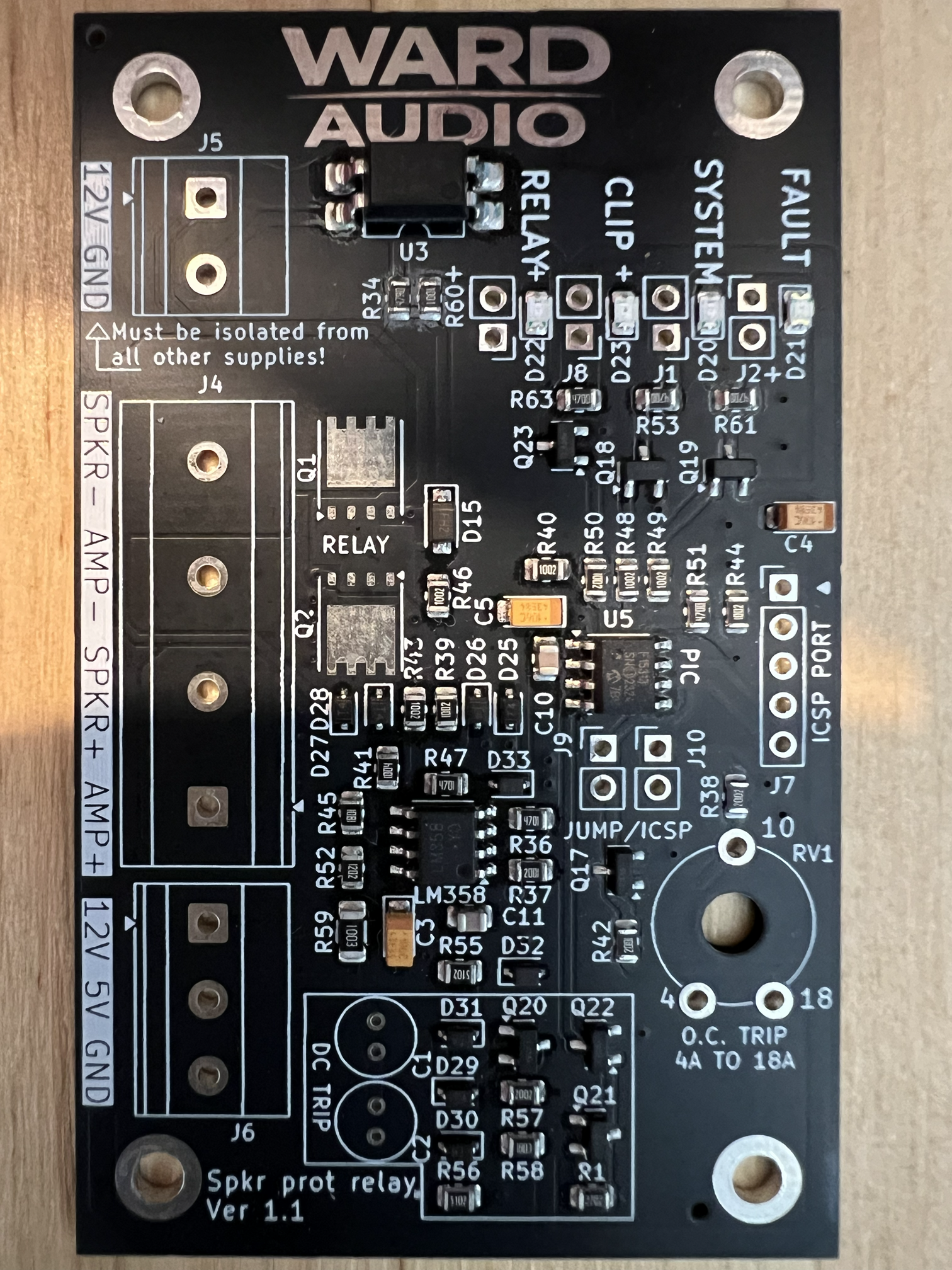
A speaker protection and amplifier monitoring system developed for Ward Audio amplifier projects.
The Ward Audio speaker protection board is designed to supervise an amplifier during startup and normal operation, while keeping the loudspeaker disconnected whenever conditions are not considered safe.
It combines DC fault detection, over-current monitoring, startup sequencing, clipping indication, automatic retry behavior, and speaker disconnect control in one system.
The controller does not simply treat every input the same at all times. Fault monitoring changes depending on the operating state of the amplifier and speaker connection.
At power-up, the speaker output remains disconnected while the surrounding analog circuitry is given time to stabilize.
Once startup conditions are valid, the controller waits for audio activity before beginning the speaker connection sequence. After audio is detected, a short arming period is used before the output switching devices are enabled.
This keeps the speaker disconnected during initial power-up and avoids connecting it unnecessarily while the amplifier is sitting idle.
Rather than using a conventional electromechanical speaker relay, the output is switched with a back-to-back MOSFET arrangement.
The goal is to retain the extremely low series resistance expected from a good speaker relay while gaining the advantages of a solid-state switch: no contacts to pit, oxidize, bounce, or gradually increase in resistance through repeated operating cycles.
The MOSFET arrangement also allows the output to be disconnected considerably faster than a conventional mechanical relay. Once a valid fault has been identified, shutdown is the first action taken by the controller.
DC monitoring is treated as a primary protection function.
Unlike over-current detection, DC faults can be evaluated even while the speaker output is still disconnected. This allows the controller to prevent the speaker path from ever being enabled if an unsafe DC condition already exists at the amplifier output.
If a valid DC fault occurs during operation, the speaker connection is removed immediately.
Because the DC detection circuitry responds according to fault magnitude and duration, more severe faults can produce much faster shutdown than smaller offsets that may require persistence before being considered dangerous.
Over-current protection is intended to protect more than just the loudspeaker. It can also act as an early response to abnormal conditions on the amplifier output, including speaker faults, accidental wiring shorts, damaged cables, and other external events that can suddenly demand excessive output current.
The trip point is widely adjustable, approximately 4 A to 18 A, allowing the protection to be matched to the amplifier, output stage, expected load, and intended application.
This gives the same basic protection system enough range to work with relatively modest amplifiers or substantially higher-current output stages.
The current-sensing circuitry is only considered meaningful after the solid-state speaker switch has been enabled and the sensing hardware has had time to stabilize. The controller therefore qualifies the over-current signal according to its operating state rather than responding to it blindly at all times.
If excessive current is detected during normal operation, the speaker MOSFETs are commanded off immediately. This allows the board to act as a first line of response to an external short or severe load fault, disconnecting the load before the amplifier's own protection circuitry necessarily has to intervene.
A fault does not necessarily result in an immediate permanent shutdown.
For recoverable events, the speaker output is disconnected and the system waits before attempting to return to normal operation. This prevents rapid fault/reconnect cycling.
Repeated faults are counted as separate events. After a limited number of fault events, the system enters a latched shutdown condition and keeps the speaker disconnected until the controller is reset or power is cycled.
A fault that remains continuously active is counted only once rather than being repeatedly registered as additional failures.
The board also monitors the audio waveform for clipping-like behavior.
Rather than attempting to calculate distortion, the controller watches the waveform for repeated periods where the signal remains at a relatively constant level while the overall signal amplitude is high enough to be significant.
When that behavior persists long enough to resemble a flattened waveform, a separate clipping indicator is activated briefly.
This is intended as a practical clipping indication rather than a precision distortion measurement.
Internally, the controller moves through several defined operating states so that each protection function is evaluated only when its information is meaningful.
The controller provides four separate operating indications:
Keeping these functions distinct makes the front-panel status easier to interpret at a glance. A user can tell not only whether a fault has occurred, but also whether the speaker switch is enabled, whether the controller considers the system healthy, and whether clipping activity is being detected.
Easy-access connections are provided for external front-panel indicators, while onboard indication is retained as well. This provides installation flexibility while maintaining local status indication on the board for setup, testing, and servicing.
This board is part of the ongoing Ward Audio amplifier development work.
The design combines analog fault-detection circuitry with a small dedicated controller that manages startup sequencing, fault qualification, recovery behavior, speaker switching, and indication.
Development is continuing, with additional testing, measurements, operating data, and product information to be added as the design progresses.